Introduction
Choosing a document digitization company is an important decision for enterprises managing large volumes of paper records, legacy archives and operational documents. The right provider needs to handle more than scanning. Organizations may also require OCR, metadata capture, indexing, quality assurance, secure document handling and structured digital output that can work with existing enterprise systems.
The Indian market includes global information-management companies, technology providers and specialized digitization service firms with different capabilities and delivery models. This guide covers 10 notable companies and explains the services they offer along with the factors enterprises should evaluate before selecting a document digitization partner.
What to Look for in a Document Digitization Company
Document digitization projects can involve thousands or millions of pages across different formats, departments and locations. A provider should therefore be evaluated on its ability to manage the complete conversion process, including document preparation, scanning, image enhancement, OCR, classification, indexing, metadata capture, quality checks and secure delivery.
The evaluation should also consider the type of records being digitized. Standard office files may require a different approach from engineering drawings, medical records, legal files, historical archives or financial documents. Enterprises should assess whether a provider can handle their document formats, volumes, security requirements, indexing structure and expected output before signing a project agreement. For a broader evaluation framework, see the guide on Document Digitization Services Checklist: 10 Things to Evaluate Before Choosing a Provider.
10 Document Digitization Companies in India
1. DIGI+ by dMACQ
DIGI+ focuses on enterprise document and data digitization, helping organizations convert physical records into searchable digital information. Its capabilities include intelligent scanning, OCR, data extraction, metadata tagging and indexing, allowing organizations to move beyond simple image conversion toward structured digital records.
For enterprises evaluating a digitization partner, the relevant consideration is how effectively physical records can be converted into usable digital assets. DIGI+ is positioned around high-volume enterprise digitization where document quality, indexing, searchability and structured output are important requirements. Explore DIGI+ by dMACQ
2. Iron Mountain
Iron Mountain provides enterprise document scanning and digitization services for physical records and specialized formats. Its India offering includes high-volume digitization, metadata capture, indexing, secure handling and delivery of digital files into repositories or its InSight DXP platform.
The company also supports specialized materials such as blueprints, maps, engineering drawings, bound books, laboratory notebooks and sensitive corporate records. Its documented process includes preparation, scanning, quality control and indexing, making its offering relevant for organizations with large or complex physical archives.
3. Datamatics
Datamatics provides intelligent document processing through its TruCap+ platform, which combines OCR, AI/ML-based processing, document classification, data extraction and validation. The platform is designed to process structured, semi-structured and unstructured documents and can work with scanned document images and handwritten content.
For enterprises considering Datamatics, an important evaluation point is the transition from document digitization to structured data extraction. TruCap+ supports multiple OCR engines and downstream integration, making it particularly relevant when digitized documents need to feed business applications rather than simply being stored as image files.
4. Xerox
Xerox provides document digitization and enterprise content management capabilities that support the conversion of physical records into organized digital content. Its capabilities can include document scanning, OCR, metadata capture, indexing and content management based on organizational requirements.
For enterprises evaluating Xerox, relevant considerations include the types of documents supported, scanning and OCR requirements, indexing and metadata structures, security controls, output formats and integration needs. The suitability of the service should be assessed against the organization's document volumes and project requirements.
5. Conduent
Conduent provides document scanning and processing services that help organizations convert physical records into searchable and structured digital information. Its capabilities include document capture, scanning, indexing, classification and digital document processing.
Enterprises evaluating Conduent should consider the provider's approach to document preparation, processing, quality control, security and digital delivery. Organizations should also assess whether the service can support their required document volumes, locations, document types and service-level expectations.
6. Access
Access provides document scanning and digitization services covering bulk scanning, backfile conversion, day-forward scanning and document imaging. Its services can cover categories such as accounts payable documents, HR records, government records, blueprints, photographs and other physical archives.
Access also describes indexing and classification capabilities that can be used to organize scanned records and improve retrieval. Its service model includes both large-scale conversion projects and recurring scanning requirements, which makes project scope and ongoing scanning needs important factors to clarify during procurement.
7. Flatworld Solutions
Flatworld Solutions provides document digitization services covering archive capture, legacy conversion, metadata tagging, hierarchy preservation and repository preparation. Its current offering also describes AI-supported workflow controls combined with specialist review for image quality, document completeness and metadata accuracy.
Its services cover different archive types and industries, including engineering, healthcare, legal, banking, government, manufacturing and education. Enterprises evaluating the provider should therefore examine how its archive-handling processes align with document complexity, metadata requirements, security controls and expected repository structure.
8. Invensis
Invensis provides outsourced data processing and document-related services that can support organizations handling large volumes of information. Its broader service portfolio includes data entry, OCR-related processing and document data handling, making it relevant for organizations where digitization also involves converting information into structured datasets.
For enterprises considering an outsourcing provider, the key evaluation point is whether the service covers the complete digitization requirement or only specific processing stages. Organizations should clarify scanning responsibility, OCR, indexing, metadata capture, quality assurance, security controls, delivery formats and integration requirements before finalizing the engagement.
9. Data Entry India
Data Entry India provides document and data processing services that include converting information from physical or image-based sources into structured digital formats. Its service portfolio covers image data entry and related document-processing requirements, which can be relevant for businesses with large volumes of paper or scanned information.
When considering a provider in this category, enterprises should distinguish between basic data entry and full document digitization. A project requiring searchable documents, OCR, metadata indexing, document classification and repository-ready output may require capabilities beyond manual data entry, so these requirements should be explicitly included in the scope.
10. Centillion Solutions & Services
Centillion provides enterprise digitization services covering physical document scanning, pre-scanning, post-scanning, indexing and metadata capture. Its service description also includes image enhancement activities such as de-skewing, de-speckling, cropping and image cleaning, followed by uploading scanned images and data to a specified central storage location.
Centillion also describes the use of OCR, intelligent data capture and integration with enterprise systems such as ERP, ECM and BPM platforms. This makes system integration an important area for evaluation when the digitization project is expected to feed downstream applications rather than simply create a digital archive.
How to Compare Document Digitization Companies
The number of pages a provider can scan is only one part of the evaluation. Enterprises should examine the complete digitization workflow, including document preparation, scanning specifications, OCR capabilities, indexing, metadata capture, quality control, exception handling and final delivery.
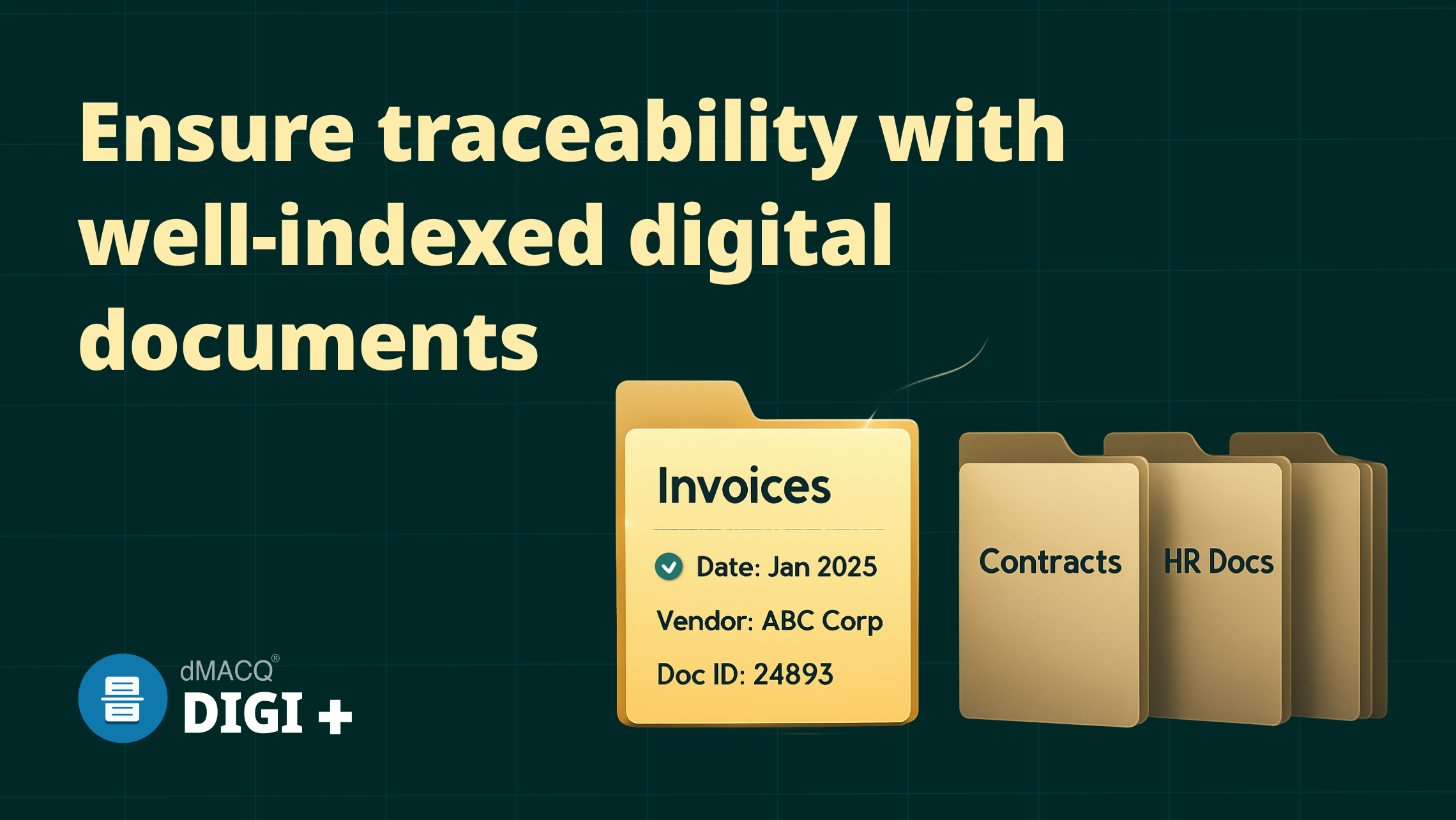
A provider that performs high-volume scanning but cannot meet the required metadata structure or output format may create additional work after the project. Organizations should therefore define technical and business requirements before comparing proposals. A structured approach to indexing is particularly important because digitized documents become significantly more useful when users can search and retrieve them using meaningful metadata. This is covered in Ensure Traceability with Well-Indexed Digital Documents.
Key Selection Factors for Enterprise Digitization
Scanning Capacity and Document Volume
Large enterprise archives can contain millions of pages accumulated across departments, branches and multiple locations. A provider should demonstrate that its infrastructure, workforce and production processes can accommodate the expected volume without compromising quality or document security.
Enterprises should ask about daily processing capacity, peak-volume handling, equipment availability, document preparation processes and contingency arrangements. The assessment should also account for specialized records such as bound documents, oversized drawings, fragile archives or mixed-format collections that may require different scanning methods.
OCR and Data Extraction Capabilities
OCR converts text within scanned documents into machine-readable information, making it possible to search, classify and extract data from digitized records. However, OCR requirements vary depending on document quality, language, layout, handwriting, tables and other characteristics.
Organizations should therefore evaluate whether a provider supports the document types involved in the project and whether extraction requires manual validation or human review. The objective should not simply be to obtain a scanned image but to create digital information that is usable for the intended business purpose.
Metadata and Indexing
Metadata determines how easily digitized records can be located and classified after conversion. Typical metadata fields may include document type, customer or employee ID, department, date, project number, document status or retention category.
A provider should be able to follow a predefined indexing structure and demonstrate how metadata will be validated before delivery. Poor indexing can turn a successful scanning project into a difficult-to-search digital archive, which is why structured indexing should be considered during provider selection rather than after scanning is complete. This is also discussed in Why Most Digitization Projects Fail Without Structured Indexing, Metadata and Governance.
Security and Chain of Custody
Physical records may contain financial information, employee records, contracts, medical information, intellectual property or other confidential data. Security therefore needs to cover the entire journey from document collection through scanning, processing, quality control and final digital delivery.
Enterprises should ask how physical files are inventoried, transported and tracked and how digital files are protected during processing and transfer. Access controls, encryption, audit trails, secure facilities and documented chain-of-custody procedures should be evaluated according to the sensitivity of the records.
Quality Assurance
Digitization quality depends on more than scanner resolution. Pages can be missing, incorrectly ordered, poorly oriented or difficult to read, while metadata can also contain classification or indexing errors.
A reliable project should include quality checks throughout the production cycle rather than relying only on a final review. Enterprises should ask about sampling procedures, image validation, page-count reconciliation, OCR validation, metadata checks and procedures for correcting rejected batches.
Integration and Digital Output
The final digital files should be delivered in formats that fit the organization's existing information architecture. Depending on the project, this may include searchable PDFs, image files, structured data, metadata files or repository-ready packages.
Integration requirements should be discussed before implementation. Organizations planning broader modernization can also consider how digitized records will connect with document repositories, enterprise applications or business processes. For context on moving historical records into modern digital environments, see Legacy Data Modernization: How Enterprises Are Unlocking Value from Decades of Paper Records.
Choosing a Provider Based on Document Type
Different document collections create different technical requirements. Standard office documents may be relatively straightforward while engineering drawings, maps, blueprints, bound books, fragile archives and handwritten records may require specialized equipment and handling.
Organizations should therefore provide prospective providers with representative document samples during the evaluation process. A pilot can help assess scan quality, OCR performance, metadata accuracy, processing speed and output compatibility before committing the full archive to production.
Why a Pilot Project Matters
A pilot provides an opportunity to test the provider's process against real documents before full-scale implementation. It can reveal issues involving paper condition, document preparation, scan quality, OCR accuracy, indexing structures or output formats that may not be apparent from a proposal.
The pilot should use representative samples rather than only clean and easy-to-process documents. If an organization manages engineering drawings, damaged records, handwritten forms or multilingual documents, those categories should be included in the evaluation so that the provider's capabilities can be assessed under realistic conditions.
Questions to Ask Before Selecting a Digitization Company
Before selecting a document digitization company, enterprises should ask specific questions about the provider's process, security practices, quality controls and commercial terms.
Key questions include:
These questions help enterprises evaluate providers consistently instead of comparing companies only on scanning capacity or headline service offerings.
How DIGI+ Supports Enterprise Document Digitization
DIGI+ is designed to help enterprises convert physical records into structured, searchable digital information through capabilities such as scanning, OCR, data extraction, metadata capture and indexing. The focus is on turning paper-based information into digital records that can be searched, organized and used within enterprise environments.
The approach is particularly relevant where organizations need to digitize large document collections while maintaining structure and traceability. Enterprises can evaluate DIGI+ alongside other providers based on their document volumes, formats, indexing requirements, security expectations and downstream system requirements. The broader principle is consistent with the article on Industry-Wise Document Digitization Services: Best Practices for Healthcare Manufacturing BFSI and Government, where digitization requirements are considered according to the characteristics of each business environment.
Frequently Asked Questions
1. What is a document digitization company?
A document digitization company helps organizations convert physical documents into digital formats. Depending on the provider, services can include document preparation, scanning, OCR, data extraction, classification, indexing, metadata capture, quality assurance and digital delivery.
The scope varies considerably between providers. Some focus primarily on scanning while others offer end-to-end digitization and data processing. Enterprises should therefore define the required output and downstream use before comparing companies.
2. How much does document digitization cost in India?
Document digitization costs depend on factors such as document volume, document condition, paper size, scanning resolution, OCR requirements, indexing complexity, metadata fields, quality-control requirements, security controls and turnaround time.
There is no single standard price that applies to every project. Organizations should request proposals based on representative document samples and a clearly defined scope rather than comparing only per-page rates.
3. What should I check before choosing a document digitization company?
Organizations should evaluate scanning capacity, OCR and extraction capabilities, indexing and metadata handling, security procedures, quality assurance, document formats, integration capabilities, turnaround times and experience with similar document types.
A pilot project can also provide a practical way to assess whether the provider can achieve the required scan quality, extraction results and metadata accuracy before the full archive is processed.
4. Is OCR necessary for document digitization?
OCR is useful when organizations need scanned documents to become searchable or when information needs to be extracted from documents. A simple image scan can preserve the visual appearance of a document but does not necessarily make its contents machine-readable.
The need for OCR depends on the intended use. Enterprises should consider OCR when searchability, automated classification, data extraction or downstream processing is part of the business requirement.
5. What is the difference between document scanning and document digitization?
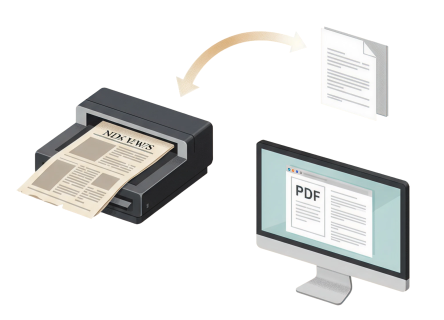
Document scanning generally refers to creating digital images from physical documents. Document digitization can involve additional steps such as OCR, classification, metadata capture, indexing, validation and structured output.
For enterprises, the distinction matters because a folder full of scanned PDFs may still be difficult to search or manage. A structured digitization process aims to make the resulting information more usable within the organization's digital environment.
Conclusion
The Indian document digitization market includes global information-management companies, technology providers and specialized service organizations with different capabilities. Companies such as dMACQ, Iron Mountain, Datamatics, Xerox, Conduent, Access, Flatworld Solutions, Invensis, Data Entry India and Centillion offer different approaches to scanning, document processing, data extraction, indexing and digital information management. The list is intended as a provider landscape rather than a ranking or endorsement.
For enterprises, the right choice depends on the nature of the records, document volume, required metadata, OCR and extraction needs, security requirements, quality standards and downstream systems. A structured evaluation supported by representative samples and a pilot project can help organizations identify whether a provider is equipped for the actual complexity of the digitization initiative rather than simply comparing scanning capacity or per-page pricing.