Introduction
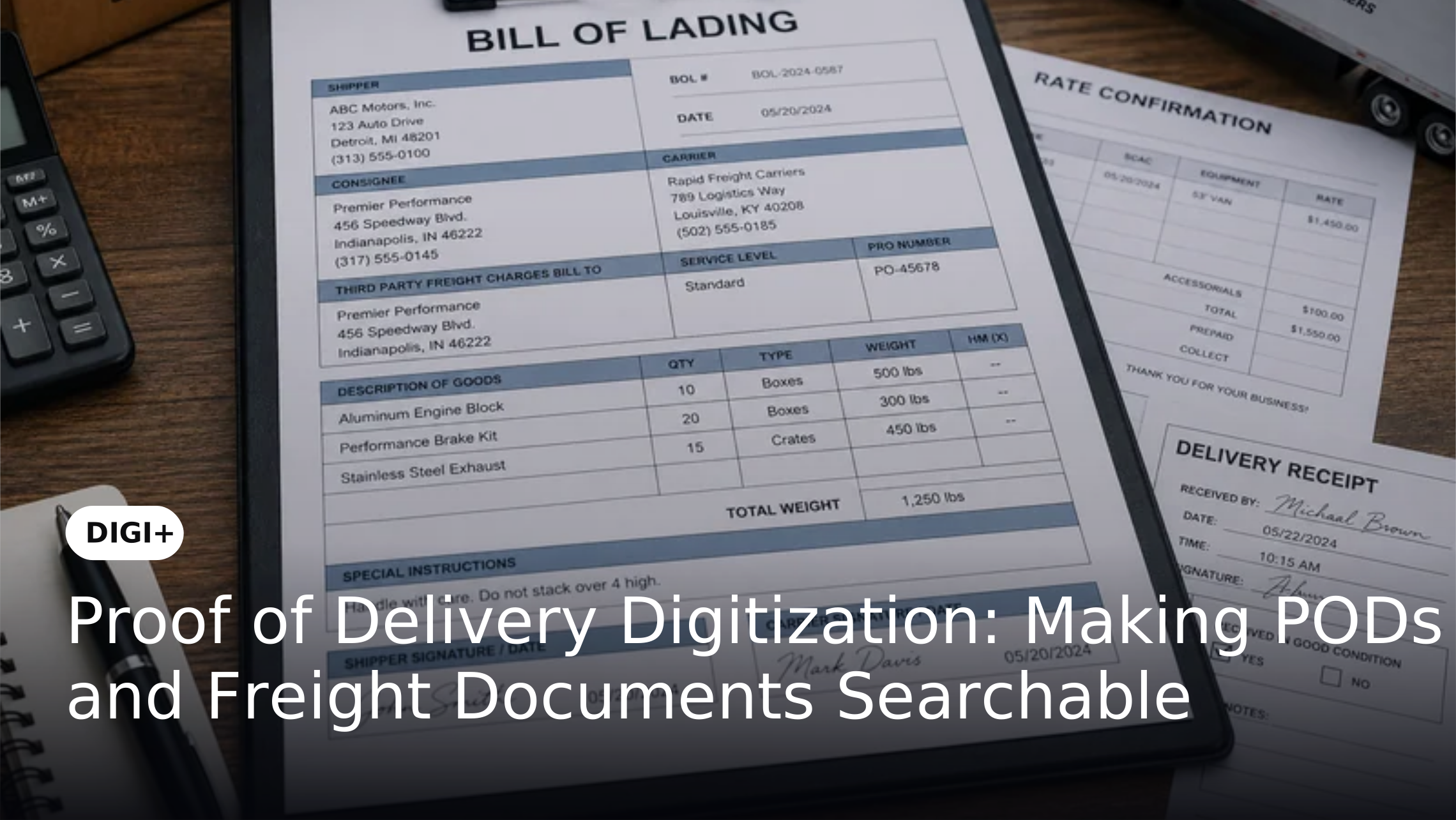
Proof of Delivery (POD) documents provide records of completed deliveries. Along with delivery receipts, consignment notes and other freight documents, they contain information that logistics companies, transport operators, manufacturers and distributors may need to retrieve long after a shipment has been completed. When these records remain in physical files, locating a specific document can require searching through folders, registers and archived paperwork.
Proof of delivery digitization converts physical records into digital files that can be searched and organized using OCR and structured indexing. Instead of relying entirely on manual filing, organizations can create searchable collections of delivery and freight records using shipment references, dates and other relevant document details.
Why Physical PODs and Freight Documents Become Difficult to Retrieve
Delivery records are generated across warehouses, distribution centres, transport offices and customer locations. Over time, completed PODs and supporting freight documents accumulate in different filing systems. Records may be grouped by delivery date, customer, transporter or shipment reference, making retrieval difficult when the original filing method is inconsistent.
The challenge becomes more significant when a business needs an older document. Employees may have to search through multiple physical files or contact different departments to locate the required record. Poor handwriting, faded printing, missing pages and inconsistent document naming can make retrieval even more difficult.
Which Documents Can Be Included in a POD Digitization Project?
A logistics document digitization project may include several types of delivery and freight records. These can include Proof of Delivery documents, delivery receipts, consignment notes, lorry receipts, goods receipts, delivery challans and supporting freight paperwork. The exact document set depends on the organization's transportation operations and recordkeeping requirements.
Digitizing these records together can help organizations establish a consistent digital collection while preserving distinctions between document types. This is particularly useful when multiple records relate to the same shipment and need to be retrieved using common references.
What Information Should Be Captured from PODs?
The information selected for indexing determines how easily a digitized POD can be retrieved. Organizations can define metadata fields around POD numbers, shipment or consignment numbers, delivery dates, customer names, consignor and consignee details, transporter names and purchase order or invoice references. Vehicle references and package details may also be relevant depending on the document format.
Not every field will appear on every document. A standardized indexing structure should account for differences between carriers, templates and historical records. Extracted information should be checked against the source document before it is treated as an accurate index value. This approach is consistent with the principles discussed in Ensure Traceability with Well-Indexed Digital Documents.
How OCR Makes POD Documents Searchable
Scanned PODs are initially digital images. Without text recognition, users may still need to open individual files and inspect them manually to locate a shipment number, recipient name or delivery date. Optical Character Recognition (OCR) identifies printed text within scanned documents and converts it into searchable text, helping users locate records using information contained in the documents.
OCR performance depends on source quality. Faded printing, handwritten entries, stamps, folds, low-resolution scans and inconsistent layouts can affect recognition accuracy. Important extracted information may therefore require manual review. OCR supports document search and retrieval, but it should not be treated as confirmation that every recognized field is correct.
Preparing PODs and Freight Records for Digitization
Before scanning begins, organizations should assess the physical condition and arrangement of their document collections. PODs may be stored as loose sheets, stapled bundles, shipment-wise files or mixed freight-document sets. Identifying these formats helps determine suitable scanning and handling requirements while reducing the risk of losing page order or document associations.
Preparation should include removing scanning obstructions where appropriate, checking page completeness, preserving relevant front-and-back information and separating fragile or damaged documents for careful handling. Duplicate copies should also be identified according to the organization's retention requirements. A consistent preparation process helps maintain the quality and context of the resulting digital records.
Indexing Digital PODs for Faster Retrieval
After scanning and OCR, digital records need a consistent indexing structure. A file name alone may not provide enough information to identify a particular delivery record, especially when multiple shipments involve the same customer or transporter. Metadata fields such as shipment numbers, POD references, delivery dates, customer names and carrier details can make records easier to organize and retrieve.
For example, a team looking for a delivery record from a previous quarter could search using a shipment reference or delivery date instead of manually checking archived files. Where several documents relate to one shipment, consistent reference fields can also help users locate associated records. The broader importance of structured metadata is covered in Why Most Digitization Projects Fail Without Structured Indexing, Metadata and Governance.
Quality Checks for Digitized Delivery Records
A digitization project should include quality checks before scanned records are accepted into the final digital collection. These checks should cover image clarity, page completeness, OCR accuracy, metadata correctness and the association of related freight documents. Particular attention should be given to shipment references, delivery dates and other fields that employees may use to locate records.
Organizations should also identify duplicate scans and establish procedures for handling unclear or incomplete documents. Comparing representative digital files with their physical originals helps identify scanning or indexing issues before they affect the wider collection. These checks improve the reliability of the searchable archive without treating digitization as independent verification of delivery.
A Practical Workflow for POD and Freight Document Digitization
A structured workflow helps organizations convert large collections of delivery records while preserving their original context. The process typically begins with assessing document volumes, types, physical condition and existing filing arrangements. Organizations can then define indexing requirements, prepare the records, scan them and apply OCR according to the document formats involved.
The resulting files should be indexed and validated before being organized into the agreed digital structure. Image quality, page completeness and important extracted fields should be checked during this process. Organizations planning a larger conversion initiative can refer to Document Digitization Project Planning: A Step-by-Step Guide for Enterprises for a broader approach to planning and execution.
How DIGI+ Supports POD and Freight Document Digitization
DIGI+ supports document digitization through capabilities such as bulk scanning, OCR, document classification and metadata indexing. These capabilities can help organizations convert accumulated physical PODs and freight records into digital files that are easier to search and retrieve. Specific extraction fields and processing requirements should be defined and validated against representative document samples.
For logistics and transportation teams managing large paper archives, structured digitization can make historical delivery records more accessible without changing the underlying delivery or shipment process. DIGI+ focuses on converting and structuring documents. Delivery confirmation, signature verification, freight dispute resolution and shipment-status management remain separate operational responsibilities.
Frequently Asked Questions
What is proof of delivery digitization?
Proof of delivery digitization is the process of converting physical POD documents into digital files. Scanning, OCR and indexing can make the resulting records easier to search and retrieve using shipment references, delivery dates and other relevant information.
Can OCR extract shipment numbers from POD documents?
OCR can recognize printed shipment numbers and other text in scanned PODs. Accuracy depends on image quality, document layout and text clarity. Important extracted values should be checked against the original documents.
Which freight documents can be digitized along with PODs?
Organizations can include delivery receipts, consignment notes, lorry receipts, goods receipts, delivery challans and other supporting freight documents, depending on their recordkeeping requirements.
Does digitizing a POD automatically verify delivery?
No. Digitization converts the document into a digital format and can make its contents searchable. It does not independently verify the recipient's signature, confirm that goods were delivered or establish the accuracy of the delivery information.
How does indexing improve the retrieval of digital PODs?
Indexing assigns searchable metadata such as shipment numbers, delivery dates, customer names and document types. Users can then locate records through relevant identifiers instead of manually browsing folders or opening individual files.
Conclusion
Physical PODs and freight documents contain information that organizations may need to retrieve long after a delivery has been completed. When these records remain in paper archives, locating specific documents can become time-consuming and dependent on inconsistent filing practices. Digitization, OCR and structured indexing help convert these collections into searchable digital records.
A successful POD digitization project requires more than scanning. It depends on suitable document preparation, clearly defined metadata, reliable image capture and quality checks that preserve the accuracy and context of each record. With a structured approach, DIGI+ can help organizations make accumulated delivery and freight documentation more accessible for everyday reference and record retrieval.