Introduction
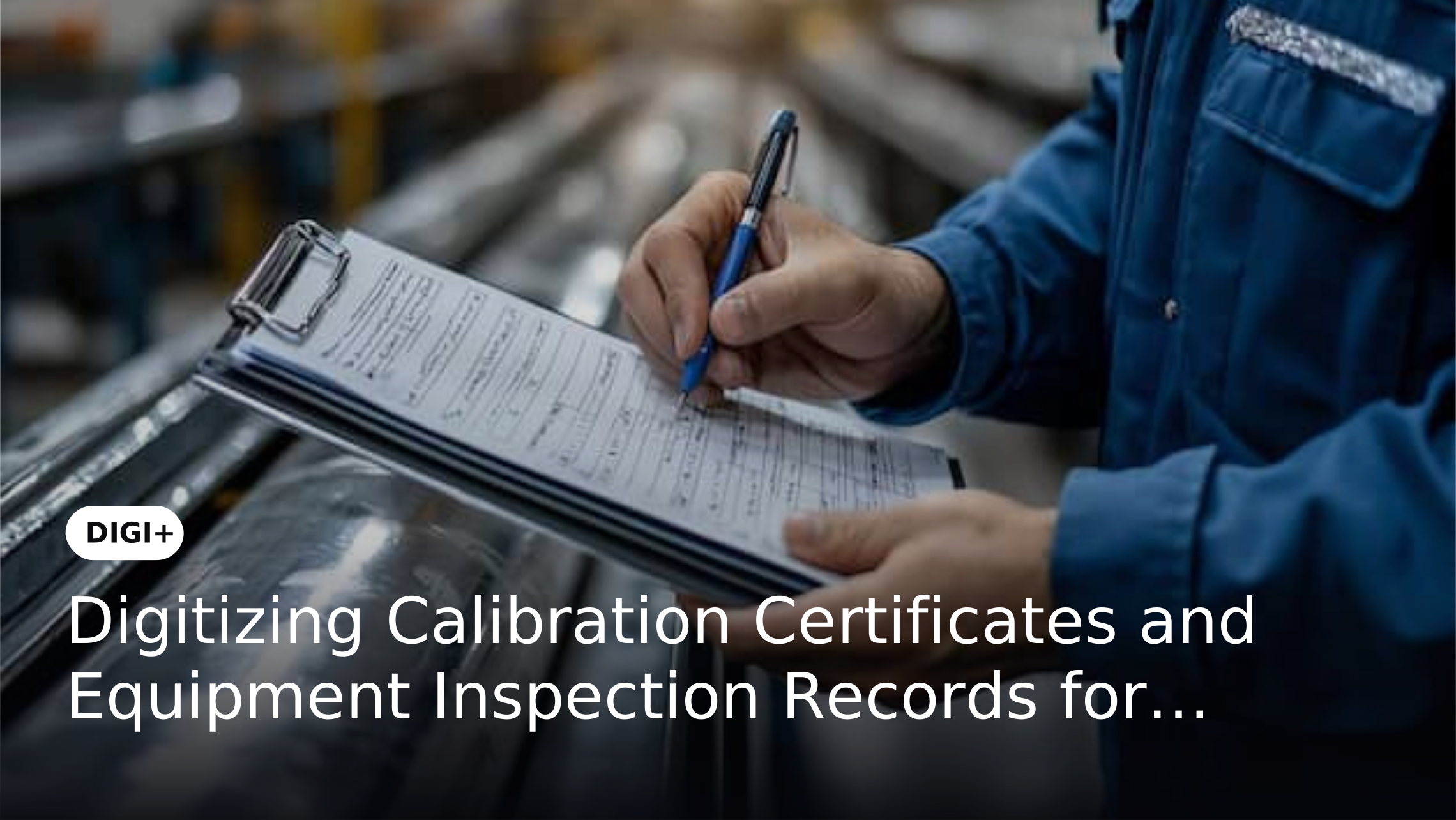
Manufacturing organizations rely on calibration certificates and equipment inspection records to document calibration activities, equipment condition and inspection findings. These records may contain instrument identifiers, calibration dates, measurement results, inspection observations and supporting signatures. When historical documents remain in paper files or disconnected folders, retrieving the correct record for a specific instrument can become time-consuming, particularly across multiple plants, production lines and storage locations.
Digitization converts physical records into digital files that can be indexed and searched using relevant information. OCR, structured metadata and quality checks can help manufacturers make historical records more accessible while retaining the original document for verification.
Why Calibration Certificates and Inspection Records Matter
Calibration certificates document the results of calibration activities for measuring instruments. Equipment inspection records document observations, checks and findings related to equipment condition or inspection activities. Depending on the organization and equipment involved, these records may support quality assurance, maintenance planning, investigations and audit preparation.
Manufacturers already exploring document digitization for ISO compliance and quality management systems may have encountered similar challenges with inspection reports, calibration certificates and production records. The specific opportunity addressed here is to organize these records around equipment identifiers, certificate references and inspection dates so that individual documents can be located and reviewed more efficiently.
Common Challenges with Paper-Based Records
Difficult Record Retrieval
A manufacturing facility may maintain records for hundreds or thousands of instruments and equipment items. Locating one certificate using only a paper register or a broad folder label can require manual searching. Digitized documents indexed by instrument ID, certificate number or date can make targeted retrieval easier.
This challenge also occurs with maintenance documentation. The article Convert Physical Logbooks into Digital Documents for Maintenance Traceability with DIGI+ explores the digitization of physical logbooks. Calibration certificates and inspection reports require a related approach but need their own document-specific fields and validation rules.
Inconsistent Document Formats
Calibration certificates may come from different laboratories or service providers, while inspection reports may use templates specific to a plant, department or equipment type. Field names, table layouts, date formats and reference numbers can therefore vary. A consistent indexing approach is needed to organize these documents without assuming they all follow the same structure.
Incomplete or Difficult-to-Read Records
Older documents may contain faded text, handwritten entries, damaged pages or unclear stamps. Scanning preserves a digital representation of the available document, but poor source quality can limit OCR accuracy. Such records need image-quality checks and manual review when important fields cannot be read reliably.
Limited Visibility Across Locations
Manufacturing organizations operating multiple facilities may store historical certificates and inspection reports locally. A consistent digitization and indexing approach can make records easier to retrieve across locations, subject to the organization's access permissions and storage arrangements.
What Information Should Be Captured?
The metadata structure should reflect the information manufacturers use to identify, retrieve and verify each record. As explained in Ensure Traceability with Well-Indexed Digital Documents, structured metadata helps users find documents using identifiers and other relevant attributes rather than relying only on file names.
Not every field will appear on every document. The indexing design should account for document type and source layout, and uncertain values should be flagged rather than inferred.
Calibration Certificate Fields
Useful fields may include:
Equipment Inspection Record Fields
Inspection records may require a different set of fields, such as:
These fields support indexing and retrieval. Extracted values must not be treated as proof that equipment is safe, compliant or fit for use without the required technical review.
How OCR Supports Calibration and Inspection Record Digitization
Optical Character Recognition (OCR) converts readable text in scanned images into machine-readable text. This can help teams search document contents and capture selected fields for indexing. Its effectiveness depends on scan quality, text clarity, document structure and the recognition technology used.
Our article on From Paper Archives to Insight-Driven Data Lakes with DIGI+ discusses the broader value of converting physical archives into digital information. For calibration and inspection records, the practical objective is more specific: accurately identify relevant fields while preserving the source document for review.
Extracting Key Fields
OCR can help identify printed instrument numbers, certificate references, dates, equipment descriptions and other relevant information. Where layouts are consistent, extraction rules can help capture these fields more systematically. Complex tables, handwritten observations, stamps and low-quality scans may require additional validation.
Handling Different Document Layouts
Certificates issued by different laboratories may present results, uncertainty values and reference details in different formats. Inspection reports may use checkboxes, tables or free-text comments. A digitization workflow should classify document types and apply suitable extraction rules instead of assuming every document follows the same template.
Preserving the Original Document
The original scan should remain available alongside extracted metadata. This lets authorized reviewers compare extracted values with the source document, investigate discrepancies and retain the context of tables, annotations, signatures and supporting pages. OCR output should not replace the original certificate or inspection report.
Building a Consistent Index for Manufacturing Records
A consistent index makes digitized documents easier to retrieve and reduces dependence on folder names or individual employees' knowledge. The principles covered in well-indexed digital document management can be applied to manufacturing records by defining suitable fields for each document type.
Use Document-Specific Metadata
Calibration certificates and inspection reports should have separate document classifications with appropriate fields. A shared equipment ID can help associate both document types with the same asset while retaining the distinction between calibration results and inspection findings.
For example, a calibration certificate might be indexed by equipment ID, certificate number and calibration date. An inspection report for the same equipment might use equipment ID, inspection date and inspection type. These fields allow teams to search by asset or retrieve records for a defined period.
Establish Naming and Classification Rules
Organizations should standardize document categories, equipment identifiers, date formats and naming conventions before processing large archives. Existing asset registers can help establish consistent identifiers where they are available. Records with missing or conflicting identifiers should be flagged for review instead of being assigned uncertain values.
Link Related Records Carefully
Where systems and data structures permit, documents can be associated with a shared equipment identifier or asset reference. This helps users find related certificates and inspection reports without merging them into one record or losing their individual document identities. Any system integration or automatic association should be validated against the organization's actual configuration.
Quality Checks Before Accepting Digitized Records
Digitization quality depends on more than whether a document has been scanned. The resulting file and its index should be checked before the record is relied upon for retrieval or review. A structured quality process should be defined during project planning. The guide to Document Digitization Project Planning: A Step-by-Step Guide for Enterprises explains why capture requirements, indexing standards and quality checks should be established before large-scale processing begins.
Image Quality and Completeness
Check that pages are legible, correctly oriented and complete. Confirm that multi-page certificates retain all relevant pages and that tables, stamps, signatures and annotations remain visible. Damaged originals should be flagged when their contents cannot be reliably recovered.
OCR and Metadata Validation
Validate important fields such as equipment IDs, certificate numbers, dates and measurement values against the original document. A single character error in an instrument identifier can cause a record to be associated with the wrong asset. Low-confidence or conflicting values should be routed for manual review where the workflow supports it.
Duplicate and Record-Matching Checks
Duplicate scans or repeated certificates may appear in legacy archives. Use available identifiers such as certificate number, equipment ID and calibration date to identify potential duplicates. Similar records should be reviewed before removal because separate documents may represent different calibration events or revisions.
Exception Handling
Maintain a review process for unreadable pages, missing fields, inconsistent identifiers and documents that cannot be classified confidently. Keep a record of unresolved issues and the decisions made by authorized reviewers. Digitization alone does not resolve incomplete source records.
A Practical Workflow for Digitizing Manufacturing Records
A structured approach can make the digitization project easier to plan and validate.
The process should include documented acceptance criteria so the organization can determine whether records are ready for use or require further correction.
Supporting Traceability Without Confusing It with Digitization
Digitized calibration certificates can make supporting documents easier to retrieve, but the presence of a digital file does not itself establish metrological traceability. According to the National Institute of Standards and Technology (NIST), traceability relates a measurement result to a reference through a documented, unbroken chain of calibrations, with each step contributing to measurement uncertainty.
For manufacturers, digitization can support access to the certificates and related documentation used in that process. Teams must still evaluate the original technical information, calibration results and applicable procedures. A scanned certificate should not be interpreted as an automatic confirmation that a measurement is fit for a particular purpose or that an instrument remains valid for use.
How DIGI+ Supports Manufacturing Document Digitization
DIGI+ supports the conversion of paper-based documents into digital records through digitization, OCR and indexing capabilities. For calibration certificates and equipment inspection records, this can help manufacturers create searchable digital copies organized by document type and relevant metadata. The extraction of instrument IDs, calibration dates, measurement results and inspection findings depends on document quality and solution configuration, so these capabilities should be validated against representative records before implementation.
For organizations that require centralized document lifecycle management after digitization, DMS+ may support the broader document management process, subject to the required configuration. Digitization improves access to source records, while technical assessments, calibration decisions, inspection approvals and compliance responsibilities remain with the appropriate personnel and systems.
Frequently Asked Questions
What is calibration certificate digitization?
Calibration certificate digitization is the process of scanning physical calibration certificates and converting them into digital files. OCR and metadata indexing can make selected information searchable and help users retrieve certificates by equipment ID, certificate number or calibration date.
Can OCR extract data from calibration certificates?
OCR can extract readable printed text and may support structured field extraction. Accuracy depends on scan quality, document layout and the recognition method. Important fields, especially instrument identifiers and measurement values, should be checked against the original certificate.
Which records should manufacturers digitize first?
Manufacturers can prioritize frequently requested calibration certificates, recent equipment inspection reports and historical records needed for defined operational or audit purposes. The selection should reflect record condition, retrieval demand, retention requirements and business priorities.
Does digitizing a calibration certificate prove that an instrument is compliant?
No. Digitization improves access to the document but does not verify the instrument's current condition, determine whether a calibration result is acceptable or establish compliance by itself. Those decisions require the relevant technical assessment and applicable procedures.
How should manufacturers handle incomplete or damaged records?
Preserve the available source image, flag missing or unreadable information and document the issue for review. Do not infer missing technical values or silently replace uncertain extracted fields with assumptions.
Conclusion
Calibration certificates and equipment inspection records provide important evidence about manufacturing equipment and inspection activities. When these records remain in paper archives, inconsistent formats, incomplete indexing and difficult retrieval can limit their usefulness. A structured digitization process can convert existing documents into searchable files while retaining the source image and organizing records around equipment identifiers, dates and document types.
The value of digitization depends on record quality, consistent metadata and validation of extracted information. By applying suitable scanning, OCR, indexing and quality checks, manufacturers can improve access to historical documentation and support their existing recordkeeping processes. DIGI+ can support the document digitization stage, while technical assessments, calibration decisions and compliance responsibilities remain with the appropriate teams and systems.