DMS+
The Importance of Document Version History
This blog explores the importance of maintaining complete document version histories for accountability, compliance, collaboration and risk reduction. It highlights how DMS+ simplifies version control with automated tracking, access-based rollbacks, audit trails and smart comparisons.
Avishek Roy Chowdhury• June 16, 2025
Introduction
In today’s fast-paced, compliance-driven work environment, knowing what changed, who changed it and when is critical. Whether it’s a legal contract, HR policy, or project proposal, documents evolve. Without a clear version history, organizations risk miscommunication, non-compliance and even legal repercussions.
Document version history isn't just a nice-to-have feature; it’s a cornerstone of responsible information management.
What Is Document Version History?
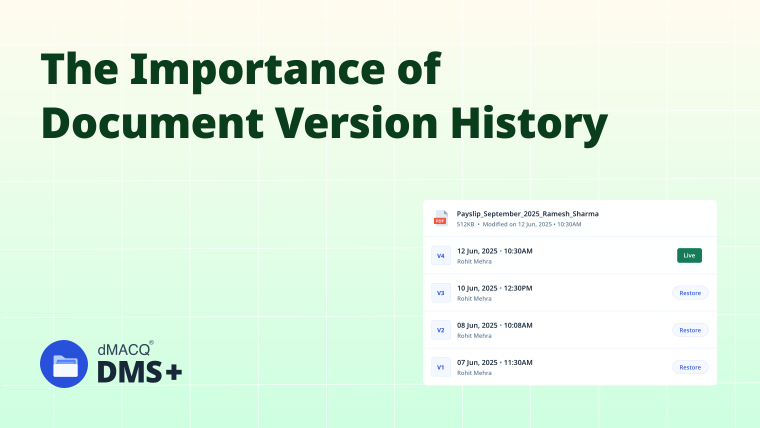
Document version history refers to the ability to track every edit, revision and change made to a file over time. This includes:
-
Who made the change
-
What was changed
-
When it was changed
-
Comments or reasons for the change
This ensures that each document’s evolution is fully documented and reversible.
Why Version History Matters
1. Ensures Accountability
Knowing who made a change creates ownership. This is vital in multi-user environments where documents pass through many hands.
2. Enables Traceability for Audits
During audits or legal reviews, having a full version trail supports compliance with regulations like ISO, GDPR and SOX.
3. Reduces Risk of Errors
Users can always revert to an earlier version if a mistake is discovered. No more “Oops, I overwrote the file” panic.
4. Supports Better Collaboration
Multiple people can edit the same document without fear of overwriting work. Everyone can view the most up-to-date content or roll back if needed.
5. Facilitates Transparent Decision-Making
Version history allows managers and teams to understand the context behind decisions made in documents (e.g., contract clause changes or policy updates).
Common Problems Without Version History
-
Data Loss: Accidental overwrites or deletions without a backup
-
Confusion: Multiple versions with names like Final_v2_FINAL_EDITED.docx
-
Non-Compliance: Missing evidence of document review or approval history
-
Rework: Redoing edits because the original version can’t be found
How DMS+ Solves Version History Challenges
DMS+ offers built-in, automated version management so users never lose track of document changes.
Key Features:
- Automatic Versioning: Every time a document is uploaded or edited, a new version is created and logged.
- Access-Based Rollbacks: Users with permission can revert to previous versions if needed—ideal for correcting errors or restoring deleted data.
- Audit Trails: DMS+ logs every action on a document—upload, view, download, update—complete with timestamps and usernames.
- Side-by-Side Comparison: Visually compare document versions to identify what changed.
- Commenting & Annotations: Capture the “why” behind a version with comments or update notes.
- Version Locking: Prevent parallel edits by locking a version while it’s under review or approval.
Real-World Impact
A legal firm using DMS+ was able to cut document revision disputes by over 70% because they could trace every clause change during contract negotiations. Similarly, an HR team used version control to track updates to company policies across quarters, helping them pass compliance audits without a hitch.
Conclusion
A document is more than its current state; it’s a living, evolving asset. Without version control, teams lose time, clarity and compliance. By implementing a robust version history system like DMS+, your organization gains control, transparency and peace of mind.
Want to see version control in action?
Book a demo of DMS+ and discover how we help you secure every step of your document journey.


Regd. & Corp. Office: C 208, Neelkanth Business Park, Nathani Road, Vidyavihar West, Mumbai, Maharashtra 400086, India.


© Copyright 2026, All Rights Reserved
Designed with

by dMACQ Solutions