Introduction
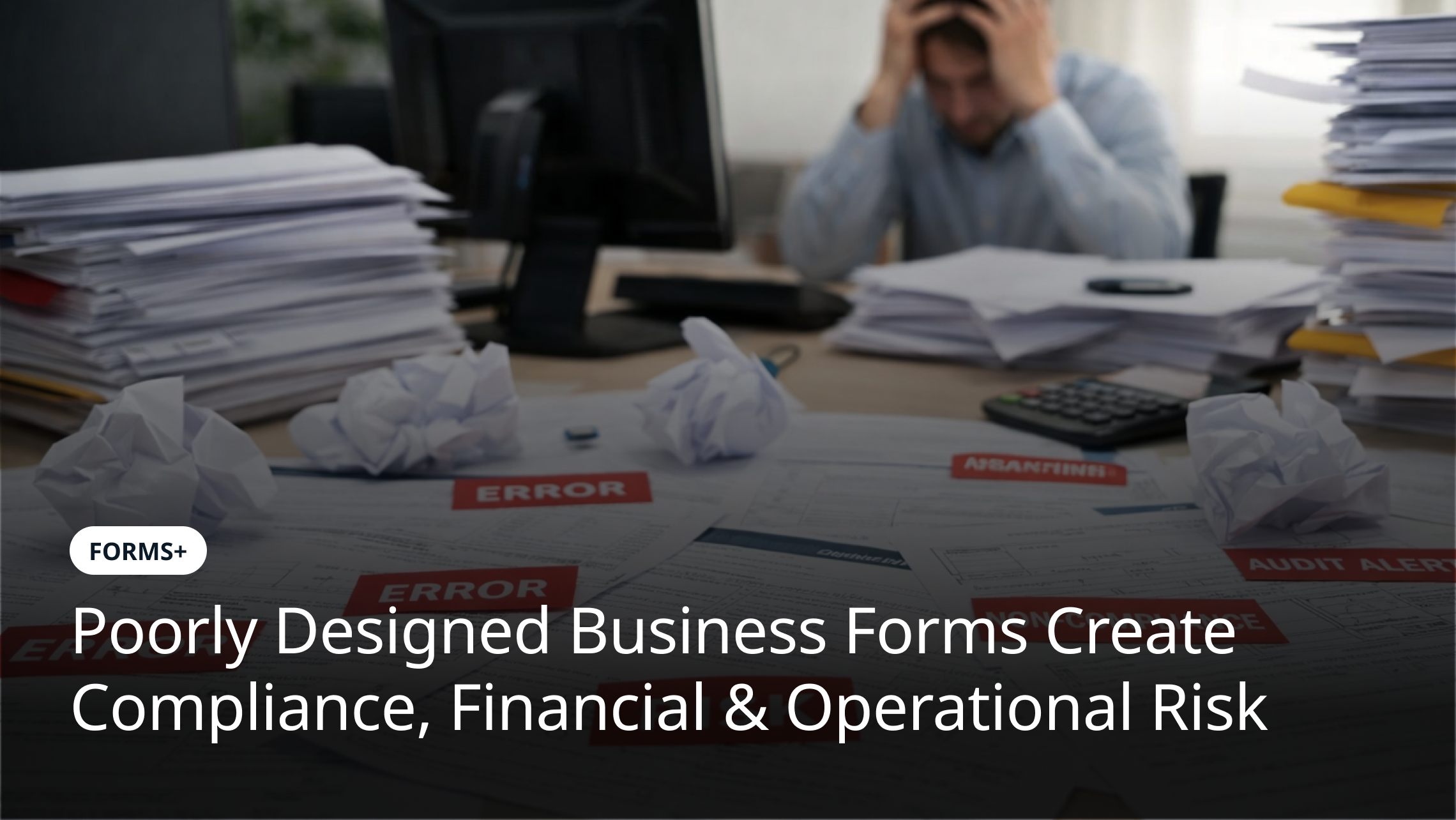
Most enterprise risks don’t begin in boardrooms, audits or financial statements. They begin at the point of data entry.
Every purchase request, vendor onboarding, hiring approval, compliance declaration, or reimbursement starts with a form. If that form is poorly designed, inconsistent, incomplete, or manually processed, the organization is already exposed.
Forms are not administrative paperwork. They are the entry gate of enterprise data governance. And when that gate lacks structure, risk flows in.
The Silent Risk Layer Most Enterprises Ignore
In many organizations, forms evolve without architectural oversight. A spreadsheet becomes a PDF. A PDF becomes a basic online form. Over time, fields are added, instructions change, approvals move through email threads and accountability becomes unclear.
What appears functional is often structurally fragile.
Common weaknesses include:
- No mandatory field enforcement
- Free-text fields where structured data is required
- Missing document attachment controls
- Manual email-based approvals
- No centralized submission visibility
- No integration with ERP, CRM, or DMS
The form doesn’t collapse immediately. It slowly weakens governance.
Compliance Risk Begins at the Form Level
Compliance failures rarely happen because policies are missing. They happen because documentation is incomplete or inconsistent.
When forms allow:
- Missing regulatory declarations
- Incorrect tax IDs or business registrations
- Incomplete KYC documentation
- No digital acknowledgment tracking
the organization unknowingly builds audit exposure.
During regulatory reviews, auditors don’t just check whether a form exists. They examine:
- Is there a traceable audit trail?
If forms lack structured validation and approval tracking, compliance gaps multiply quietly.
Compliance risk starts at submission — not at audit time.
Financial Risk Through Inaccurate Form Inputs
Financial integrity depends heavily on clean, validated inputs.
When purchase or expense forms lack validation logic, organizations face:
- Incorrect cost center tagging
- Overpayment or unauthorized spending
Manual re-entry of form data into ERP systems increases error probability.
A simple missing field can distort reporting. An incorrect amount can affect forecasting. An unvalidated vendor ID can lead to payment disputes.
Financial risk doesn’t come from complexity. It comes from uncontrolled inputs.
Operational Risk: Email Is Not Workflow
Many enterprises still rely on email-based approvals. Forms are submitted, forwarded, followed up on and occasionally forgotten. There is no centralized dashboard. No real-time status. No escalation mechanism.
This creates:
- Constant follow-up dependency
When processes rely on reminders instead of automation, execution becomes fragile.
Operational risk isn’t about workload volume. It’s about visibility and control.
Data Integrity Risk: Poor Inputs Corrupt Enterprise Intelligence
Modern enterprises rely on dashboards, analytics and performance metrics.
But analytics are only as accurate as the data captured at the source.
If forms allow:
- Inconsistent naming conventions
- Optional compliance fields
then downstream reporting becomes unreliable. Leadership decisions become based on distorted data. Garbage in doesn’t just stay at the form level. It contaminates enterprise intelligence.
How FORMS+ Transforms Forms into Governance Engines
FORMS+ is not just a digital form builder. It is a structured data governance platform that ensures every submission is accurate, validated, traceable and workflow-driven.
Instead of static templates, enterprises deploy intelligent forms that:
- Enforce mandatory validation rules
- Apply dynamic field logic based on context
- Trigger automated approval workflows
- Route submissions based on thresholds
- Escalate delayed approvals automatically
- Provide real-time dashboards
- Integrate directly with ERP, CRM and DMS systems
- Maintain full audit trails for every action
The shift is architectural. Forms move from passive data collectors to controlled workflow triggers.
Real-World Impact
Organizations that redesigned their business forms using structured digital workflows report measurable improvements:
- 60–80% reduction in data entry errors
- Faster approval cycle times across departments
- Significant drop in compliance observations
- Improved financial accuracy and reporting integrity
- Reduced SLA breaches through automated routing
- Stronger audit traceability with complete submission history
More importantly, they eliminate the silent decay caused by poor form architecture. They move from reactive correction to proactive control.
The Strategic Shift: From Paperwork to Risk Architecture
The fundamental issue is not digitization. It is structure. Simply converting paper to online forms does not eliminate risk. Without validation, logic, routing and audit tracking, digital forms can be just as dangerous as manual ones.
FORMS+ enables enterprises to:
- Standardize data collection across departments
- Eliminate manual follow-ups
- Enforce compliance at submission
- Protect financial governance
- Create operational transparency
Risk doesn’t start with policy failure. It starts when someone submits incomplete information without control.
Conclusion
Poorly designed business forms quietly create compliance gaps, financial inaccuracies and operational inefficiencies. The damage is gradual but cumulative. Enterprises that treat forms as strategic control points rather than administrative tools that build stronger foundations for governance, audit readiness and operational scale.
With structured, intelligent and automated digital forms through FORMS+, organizations control risk at the source. Because better forms don’t just collect data. They protect the enterprise.