Introduction
Workflow automation security is no longer a narrow IT concern. As enterprises connect approvals, employee processes, finance operations, customer data and business applications through automated workflows, the workflow platform can become part of the organization's operational and data security boundary. A weak permission model or poorly secured integration can create risk across multiple connected systems.
For enterprise buyers, the question is not simply whether a workflow automation platform is secure. The more useful question is whether its security controls match the organization's data sensitivity, regulatory obligations, integration architecture and operating model. This guide outlines the security areas CIOs, CTOs, COOs, IT leaders and process owners should evaluate before adopting workflow automation at scale.
Why Workflow Automation Security Matters Before Adoption
Workflow automation connects people, applications, data and business rules into a coordinated process. A single workflow may receive information through a form, route it to several employees, retrieve information from an enterprise application, trigger an approval and store supporting documents. Each connection creates a point that needs appropriate security controls.
The scale of the potential impact makes security a platform-selection issue rather than a post-implementation task. IBM's 2026 Cost of a Data Breach Report found that the global average cost of a data breach reached $4.99 million, a record high. The report also found a 56% increase in AI-driven attacks. IBM reported that extensive use of AI and automation in security was associated with approximately $1.93 million in breach-cost savings compared with organizations using none. Source: IBM Cost of a Data Breach Report 2026.
For Indian enterprises the issue is equally significant. IBM reported that the average cost of a data breach in India reached INR 255 million in 2026, up 15.9% from INR 220 million in 2025. Source: IBM India Cost of a Data Breach Report 2026.
Security therefore needs to be considered alongside functionality, scalability and integration capability when enterprises evaluate workflow automation platforms.
What Security Areas Should Enterprises Evaluate?
A strong evaluation should examine the entire workflow environment rather than focusing on one security feature. The following areas provide a practical framework for evaluating a workflow automation platform before adoption.
1. Identity and Access Management
The first question should be who can access the platform and how their identity is verified. Enterprises should evaluate support for enterprise authentication mechanisms, single sign-on, multifactor authentication and centralized user management.
The platform should also support appropriate access provisioning when employees join the organization, change roles or leave. Access should be aligned with job responsibilities so users do not retain permissions that are no longer required.
2. Role-Based Access Control
Role-based access control should allow enterprises to determine what different users can see and do within the platform.
For example, a process owner may be allowed to configure a workflow while an approver may only be allowed to review and approve assigned requests. An administrator may have broader configuration privileges while business users receive access only to the processes relevant to their roles.
NIST identifies least privilege as a security principle that limits user or process access to what is necessary for assigned organizational tasks. It also recommends reviewing assigned privileges periodically and removing or reassessing them when necessary. Source: NIST SP 800-171 Rev. 3.
3. Privileged Access Management
Administrative accounts require additional scrutiny because they can potentially modify workflows, permissions, integrations and security settings.
Enterprises should evaluate whether privileged activities can be restricted and monitored. They should also understand how administrative accounts, service accounts and other non-human identities are managed.
NIST guidance specifically addresses privileged accounts and recommends restricting privileged access while logging the execution of privileged functions. Source: NIST SP 800-171 Rev. 3.
4. Data Encryption
Workflow platforms may handle sensitive business information while data is being transferred between applications or stored within the platform.
Enterprises should evaluate encryption for data in transit and data at rest. The assessment should also consider workflow attachments, documents, logs, backups and temporary data rather than focusing only on the primary application database.
5. Workflow-Level Permissions
Platform-level security is not sufficient if individual workflows cannot enforce appropriate permissions. A procurement workflow may involve financial information while an HR workflow may contain employee information.
Users should not automatically receive access to every workflow simply because they have access to the broader automation platform. Enterprises should therefore evaluate whether permissions can be applied at the process, task, record or activity level where required.
6. Audit Trails and Activity Logging
Every important workflow action should be traceable. Enterprises should evaluate whether the platform records workflow creation, configuration changes, approvals, rejections, access events and administrative activities. Audit trails are useful for security investigations and compliance reviews. They also create operational accountability by showing who performed an action, what happened and when it occurred.
NIST recommends generating audit records for selected events while protecting audit information from unauthorized access, modification or deletion. Source: NIST SP 800-171 Rev. 3.
This approach becomes even more important when workflows require version control, audit trails and lifecycle management. Clear controls help enterprises track changes, maintain accountability and ensure workflows remain governed as they evolve. Learn more in [Workflow Governance with Versioning, Audits and Lifecycle Management in FLOW+](internal link).
7. API and Integration Security
Enterprise workflow automation rarely operates in isolation. Workflows may connect with ERP, CRM, HRMS, finance systems, document repositories and third-party applications. This makes API and integration security a major evaluation area. Enterprises should examine authentication methods, authorization, credential management, token handling, data transmission and the permissions granted to connected systems.
The organization should also understand whether an integration can only read information or whether it can create, modify or delete records. The level of access should match the actual business requirement.
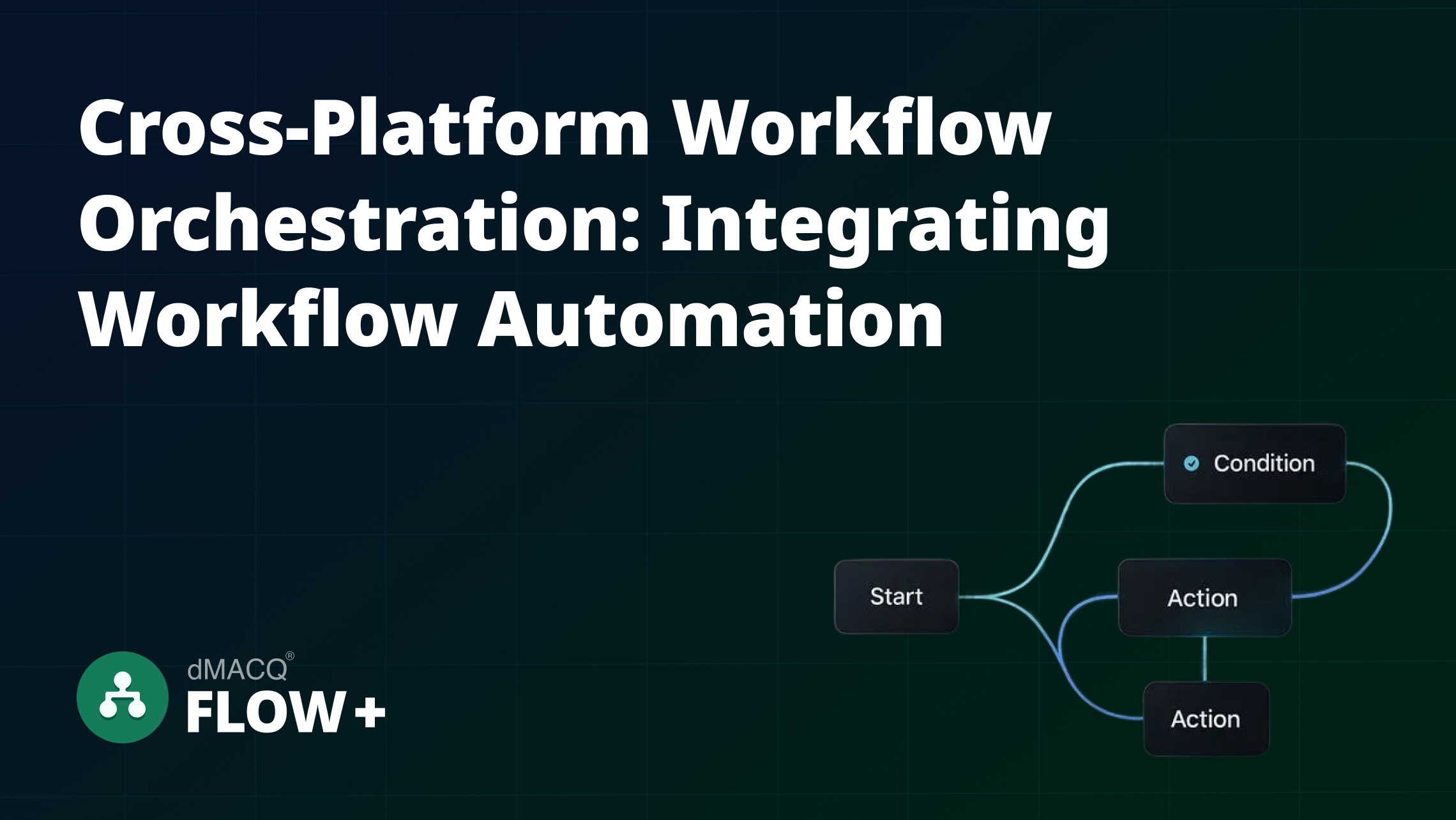
Security considerations also extend to workflows that connect ERP, CRM and third-party applications. As data moves across multiple systems, enterprises need appropriate controls to protect integrations, manage access and maintain visibility over data movement. Explore Cross-Platform Workflow Orchestration: Integrating Workflow Automation With ERP, CRM And Third-Party Apps for a deeper look at connected enterprise workflows.
8. Data Governance and Data Residency
Before adopting a workflow automation platform enterprises should understand where their workflow data is stored and processed.
The evaluation should cover:
Organizations operating across multiple jurisdictions should also assess whether the platform supports their applicable privacy and data-governance requirements.
9. Compliance and Regulatory Controls
Security requirements often depend on the industry and geography in which the enterprise operates. Organizations should identify which regulatory requirements apply to their workflows and determine whether the platform provides controls that support those obligations.
Relevant considerations may include privacy regulations, financial controls, industry-specific requirements and internal governance policies. For organizations operating across regulated environments, workflow governance must also support consistent controls across teams, locations and business processes. FLOW+ Enables Compliance Workflow Governance Across Global Operations explores how governance can help enterprises maintain control and compliance as workflows scale across global operations.
10. Security Monitoring and Incident Response
Security controls need visibility. Enterprises should evaluate whether the platform provides sufficient monitoring to identify suspicious activity, unusual access patterns, failed authentication attempts and unauthorized configuration changes.
The platform should also fit into the organization's broader incident-response process. Security teams should understand what information is available during an investigation and how quickly access or workflow activity can be reviewed.
11. Backup, Recovery and Business Continuity
Security is not limited to preventing unauthorized access. Enterprises also need to understand what happens when a system becomes unavailable or data needs to be restored.
Evaluate:
Critical workflows should have recovery arrangements that match their business importance.
12. Vendor Security and Ongoing Assurance
The vendor itself becomes part of the enterprise security ecosystem. Organizations should evaluate the vendor's security governance, vulnerability-management practices, security testing processes and incident-response procedures.
Security should also be reviewed after implementation. As workflows change, new integrations are added and users move between roles, the security configuration may need to evolve.
How to Evaluate Workflow Automation Security Before Selecting a Platform
A practical evaluation should combine technical assessment with business requirements.
Step 1: Classify the Workflows
Start by identifying which processes will be automated and what type of information each process handles. A low-risk administrative workflow may require a different security posture from a workflow handling financial transactions, employee records or sensitive customer information.
Step 2: Identify Required Access
Document who needs access to each workflow and what actions they need to perform. This creates a baseline for evaluating role-based permissions and least-privilege requirements.
Step 3: Map Integrations
List every application that the workflow needs to connect with and identify what information moves between systems. This helps security teams assess API permissions and integration exposure before implementation.
Step 4: Define Audit Requirements
Determine which activities need to be recorded and how long records need to be retained. For regulated or financially significant processes, auditability may be a core requirement rather than an optional feature.
Step 5: Validate Vendor Controls
Ask vendors for specific information about authentication, authorization, encryption, logging, data handling, incident response, backup and security governance. Avoid relying on broad claims such as "enterprise-grade security." The evaluation should focus on specific controls that can be verified.
Workflow Automation Security Checklist for Enterprises
Before selecting a platform, enterprise teams should be able to answer the following questions:
This checklist can be used by IT, cybersecurity, compliance and business teams during platform evaluation.
Security Should Be Built Into Workflow Design
Security should not be treated as a separate layer added after workflows have been created. Access controls, approval rules, audit requirements and integration permissions should be considered while the workflow itself is being designed.
Strong workflow governance starts with clearly defined approval hierarchies, role-based access, audit trails and standardized business rules. These principles also form the foundation of a high-impact business process automation strategy. Read 8 Steps to a High-Impact Business Process Automation Strategy to explore how enterprises can structure automation for greater control and consistency.
The objective is to make security part of the operating model rather than a one-time implementation activity.
Real-World Example: Securing an Employee Onboarding Workflow
Consider an enterprise employee onboarding process where HR collects employee information, IT provisions accounts and equipment while administration manages supporting documents. Without structured controls, sensitive employee information may move through email, spreadsheets and multiple shared repositories.
A secure automated design could use Forms+ for structured information capture while FLOW+ coordinates HR tasks, IT activities, approvals and notifications. DMS+ can manage supporting documents with appropriate access controls while the workflow records important actions for accountability.
The security model can then restrict information according to responsibility. HR can access employee information while IT receives only the information required for provisioning. Administrators can manage workflow configuration while employees receive access only to their assigned tasks.
The example demonstrates an important principle: workflow automation security should follow the process and the sensitivity of the information rather than applying identical access to every participant.
How FLOW+ Supports Secure Enterprise Workflows
FLOW+ can help enterprises build structured workflows around approvals, business rules, access controls, task routing and auditability.
Its value is not limited to automating individual tasks. FLOW+ can coordinate business processes across departments while providing a structured framework for managing who performs each activity and how work moves from one stage to another.
For processes that involve multiple information types, FLOW+ can work alongside complementary solutions. Forms+ can support structured data capture while DMS+ can support document management. Where financial processes are involved, AccountsPayable+ can support downstream accounts payable activities. FLOW+ remains the orchestration layer that coordinates the broader business process.
Questions to Ask a Workflow Automation Vendor
Before selecting a workflow automation platform, enterprises should ask vendors specific security questions to understand how the platform protects workflows, data, users and integrations. The answers should be evaluated against the organization’s security policies, compliance requirements and risk tolerance.
1. How does the platform manage user access?
Ask how the platform supports identity management, single sign-on, multi-factor authentication and role-based access. Confirm whether permissions can be customized based on user roles and responsibilities.
2. Can access be controlled at the workflow level?
Determine whether administrators can restrict access to specific workflows, stages, actions or sensitive data. Fine-grained permissions are particularly important when workflows involve confidential information or high-impact business decisions.
3. How are privileged activities controlled?
Ask how administrative privileges are assigned, monitored and reviewed. Confirm whether privileged actions are logged and whether access can be limited according to the principle of least privilege.
4. How is workflow data protected?
Understand what encryption is used for data in transit and at rest. Also ask where data is stored, how data residency is managed and what controls apply to sensitive business information.
5. How are integrations and APIs secured?
For platforms that connect with ERP, CRM and other enterprise applications, ask how APIs are authenticated and protected. Clarify how credentials, tokens and data exchanged between systems are secured.
6. What audit and monitoring capabilities are available?
Confirm whether the platform maintains detailed audit logs covering user activity, workflow changes, approvals, administrative actions and security events. Ask how long logs are retained and whether they can be integrated with existing monitoring tools.
7. Which compliance and security standards does the platform support?
Ask which security certifications, compliance frameworks and independent assessments apply to the platform. Enterprises should verify that these align with their industry requirements and internal security policies.
8. How does the vendor handle security incidents?
Understand the vendor’s incident detection, response and notification processes. Ask about escalation procedures, communication timelines and the responsibilities of both the vendor and customer during a security incident.
9. How does security evolve after deployment?
Security evaluation should not end at implementation. Ask how vulnerabilities are identified and remediated, how security updates are managed and how customers are informed about significant security changes.
10. What backup and recovery measures are available?
Confirm how workflow configurations and business data are backed up and restored. Ask about recovery objectives, disaster recovery procedures and business continuity measures to understand how the platform will support operations during disruptions.
Conclusion
Workflow automation can become a critical layer connecting people, applications, data and business processes across an enterprise. That makes security a fundamental part of platform selection rather than a technical consideration that can be postponed. Enterprises should evaluate identity management, access controls, privileged access, encryption, audit trails, integrations, data governance, monitoring, compliance and recovery before adopting a platform.
A security-first approach also provides a stronger foundation for scaling automation. With FLOW+ enterprises can structure approvals, business rules, access controls, task routing and auditability while complementary solutions can support forms, documents and specialized business processes where appropriate. The goal is not simply to automate more work but to create controlled workflows that enterprises can operate with confidence as automation expands.