Introduction
Mumbai has a large and diverse technology ecosystem, which means businesses evaluating automation partners can encounter companies offering very different types of automation. Some focus on industrial automation, others on software development, AI, IT services or business process automation. For enterprises looking for workflow automation, the important question is not simply which automation company is nearby but whether the partner can understand business processes, integrate existing systems and support automation at enterprise scale.
Choosing the right partner becomes particularly important when automation affects finance, HR, procurement, legal, operations or other business-critical functions. The right business automation software should fit the organization's processes rather than forcing teams into rigid workflows. A reliable automation partner should also be able to translate business requirements into scalable workflows, manage implementation and provide ongoing support as processes evolve.
What Do Automation Companies in Mumbai Offer?
The term automation companies in Mumbai covers a broad range of technology providers. Depending on the company's specialization, automation services may include industrial control systems, robotic automation, software development, AI solutions, IT automation or business process automation. Enterprises should therefore define the type of automation they need before comparing providers because a company that specializes in physical or industrial automation may not be the right fit for automating approvals, employee requests, procurement processes or document-driven business workflows.
For business process automation, the focus should be on capabilities such as workflow design, approval routing, business rules, system integration, process monitoring and governance. A suitable provider should be able to connect automation with the applications employees already use while giving business teams visibility into how work moves across departments. This distinction helps enterprises narrow a broad local search into providers that actually match their operational requirements.
Why Choosing the Right Automation Partner Matters
Business automation affects more than individual tasks. When workflows are connected to ERP, CRM, HRMS, document management or finance systems, implementation decisions can influence data movement, approvals, user access and operational continuity. A poorly aligned solution can create another layer of complexity instead of removing existing process bottlenecks. This is why enterprises should evaluate the partner's ability to understand the complete business process rather than selecting software based only on features or price.
The partner also becomes important after implementation. Business processes change as organizations introduce new approval levels, departments, compliance requirements and applications. A provider that can support workflow changes, integrations, performance monitoring and user adoption can help the automation environment evolve with the organization. This makes partner capability a long-term consideration rather than a one-time procurement decision.
Start With Your Business Automation Requirements
Before contacting automation companies in Mumbai, define the business problems that automation needs to solve. Identify processes involving repetitive work, multiple approvals, manual data entry, frequent follow-ups, document exchanges or handoffs between departments. Establishing these requirements makes it easier to determine whether a prospective partner has relevant experience and whether its automation software can support the process without unnecessary customization.
It is also useful to define the systems that need to participate in the workflow. An automation initiative may need to connect ERP, CRM, HRMS, email, document repositories or other enterprise applications. Your existing What is Workflow Automation and How Can It Transform Your Business? explains how workflow automation connects repetitive tasks with business systems. That foundation can help decision-makers identify the processes and integrations that a prospective partner must be able to support.
Evaluate Workflow Automation Expertise
A business automation partner should demonstrate more than the ability to configure software. Look for experience designing workflows around real business processes such as procurement approvals, employee onboarding, vendor management, expense approvals, contract reviews or service requests. The partner should be able to understand current-state processes, identify bottlenecks and translate business rules into structured workflows while preserving appropriate human decision points.
Ask potential providers how they handle sequential and parallel approvals, conditional routing, exceptions, escalations and changes in approval hierarchies. These capabilities become particularly important in larger organizations where the same process may vary by department, location, business unit or transaction value. A partner that understands these complexities is better positioned to design automation that reflects how the enterprise actually operates.
Assess the Automation Software It Supports
The automation software should provide the core capabilities required to build and manage enterprise workflows. These can include workflow design, configurable approval rules, notifications, task assignment, SLA monitoring, dashboards, audit trails, role-based access and integration capabilities. The objective is not to select the platform with the longest feature list but to determine whether its capabilities correspond to the processes identified during the requirements stage.
Usability should also be considered because business automation often involves collaboration between IT and business teams. If every workflow change requires extensive development effort, organizations may struggle to adapt processes quickly. A platform that enables appropriate business-user participation while maintaining IT governance can make it easier to expand automation beyond the initial implementation.
Check Integration Capabilities
Enterprise automation rarely operates in isolation. A workflow may need information from an ERP system, trigger an action in a CRM, retrieve documents from a repository or send completed information to another business application. Integration capabilities should therefore be evaluated as part of the partner selection process rather than treated as an implementation detail after the software has been chosen.
Ask prospective partners how they approach APIs, pre-built connectors, authentication, data synchronization and error handling. They should also explain how integrations will be monitored and maintained when connected applications change. This is especially important when automation becomes part of a business-critical process because an integration failure can affect the entire workflow rather than just one application.
Evaluate Security and Governance
Security requirements should be evaluated before a workflow automation project begins. The partner should be able to explain how the proposed solution manages user authentication, role-based access, sensitive information, audit trails, workflow permissions and administrative access. Enterprises operating in regulated environments should also establish how the automation environment supports internal governance and compliance requirements.
Governance should extend beyond security controls. Ask how workflows are versioned, tested, approved and changed after deployment. A mature automation partner should have a clear approach to managing workflow modifications without disrupting active business processes. This becomes increasingly important as organizations move from individual automation projects toward enterprise-wide automation programs.
Examine Implementation Methodology
A strong automation partner should have a structured implementation methodology rather than moving directly from software demonstration to deployment. The process should typically include requirements discovery, process assessment, workflow design, integration planning, configuration, testing, user acceptance and deployment. The partner should also establish how business stakeholders participate throughout these stages so that the resulting workflow reflects operational requirements.
Implementation should begin with a clearly defined process and measurable objective. Your existing 8 Steps to a High-Impact Business Process Automation Strategy emphasizes prioritizing high-impact processes and defining business objectives before expanding automation. The same principle applies when evaluating a local automation partner because a provider should be able to demonstrate how it turns business objectives into practical automation initiatives.
Look at Local Support and Responsiveness
For enterprises searching for automation companies in Mumbai, local presence can be useful when business stakeholders need workshops, implementation discussions or on-site coordination. However, physical proximity should not be treated as a substitute for technical capability. A nearby provider still needs the expertise, implementation methodology and support structure required for enterprise automation.
Evaluate how support is handled after implementation. Ask about response processes, escalation paths, service-level commitments, workflow changes and technical troubleshooting. The objective is to understand whether the partner can support the automation environment throughout its lifecycle rather than only during the initial deployment.
Review Scalability Before Selecting a Partner
An automation initiative that starts with one department may eventually expand across procurement, finance, HR, legal, operations and other functions. The selected business automation software should therefore be able to support additional workflows, users, integrations and approval structures without requiring the organization to replace its technology foundation every time its automation requirements grow.
The partner should also have a clear approach to scaling automation. This includes identifying additional use cases, reusing established components, managing governance and monitoring workflow performance. Your existing Signs Your Business Has Outgrown Manual Workflow Management explains how increasing process complexity, disconnected systems, approval delays and limited visibility can indicate the need for more structured workflow management.
Ask for a Proof of Concept
A proof of concept can help enterprises evaluate whether an automation partner can translate requirements into a working process. Instead of testing every possible feature, select one representative workflow with clearly defined inputs, approvals, business rules and expected outcomes. This allows the organization to assess the partner's implementation approach using a real business scenario.
During the proof of concept, evaluate workflow usability, integration behavior, exception handling, reporting, security controls and the time required to make changes. The objective should be to understand how the partner works and how well the solution fits the organization's operating model rather than simply confirming that a workflow can be demonstrated.
Compare Partners Beyond Software Pricing
Price is an important procurement consideration but it should not be the only comparison point. A lower software cost may not represent a lower total cost if implementation requires extensive customization, integrations are difficult to maintain or employees require substantial external support for routine workflow changes. Evaluate the complete commercial model, including implementation, integrations, licensing, support, training and future expansion.
The business case should also consider measurable operational outcomes. Deloitte's research on automation ROI recommends evaluating automation through multiple dimensions including cost savings, productivity, scalability, quality, process insights and governance rather than focusing exclusively on direct cost reduction. This broader approach can help enterprises compare partners based on expected business value instead of software price alone.
Consider Industry and Process Experience
Industry experience can be valuable when automation involves specialized compliance requirements, approval structures or operating procedures. A partner familiar with the organization's industry may already understand common process patterns and regulatory considerations. However, industry experience should be evaluated alongside actual workflow capability because familiarity with an industry does not automatically demonstrate expertise in enterprise process automation.
Ask prospective partners for examples of comparable workflows rather than generic customer logos. Look for evidence that they have handled processes involving similar transaction volumes, approval complexity, integrations and governance requirements. The more closely the examples match the organization's actual process challenges, the more useful they are for evaluating implementation capability.
Evaluate the Partner's Ability to Measure Outcomes
Automation should be measurable after implementation. Before selecting a partner, establish how workflow performance will be monitored and which metrics will determine whether the initiative is successful. Useful measures can include processing time, cycle time, approval turnaround, exception rates, SLA performance, transaction volumes and manual effort.
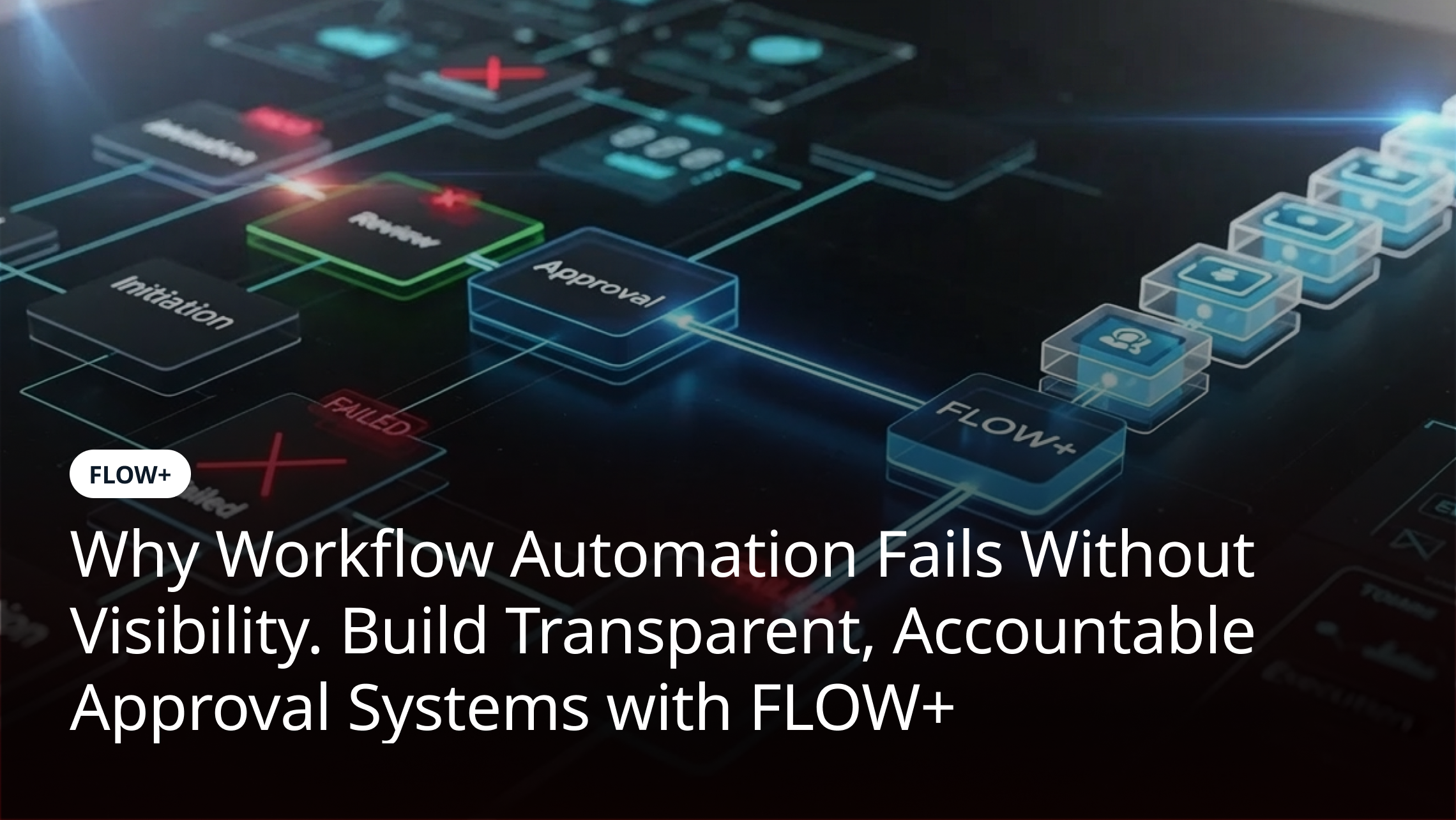
This approach also supports continuous improvement. If a workflow consistently shows delays at one stage, the organization should be able to identify the bottleneck and modify the process rather than treating implementation as the end of the project. FLOW+ provides workflow monitoring and real-time activity visibility that can support this ongoing approach to process improvement.
How FLOW+ Fits Enterprise Automation Requirements
FLOW+ is designed for business process automation, allowing organizations to configure workflows, approval hierarchies, notifications, task management and process monitoring. It can support workflows that involve multiple departments and enterprise applications while providing visibility into workflow progress and bottlenecks. This makes it relevant for organizations looking beyond isolated task automation toward structured business processes.
The broader dMACQ ecosystem can also support different stages of an automated business process where required. FORMS+ can capture structured business information, DMS+ can manage documents and FLOW+ can orchestrate the process. This connected approach allows organizations to evaluate automation as an end-to-end business process rather than selecting disconnected tools for individual tasks.
Questions to Ask Automation Companies in Mumbai
Before selecting a provider, ask how it approaches process discovery, workflow design, integrations, security, implementation and post-deployment support. Questions should also cover who owns the workflow after implementation, how changes are managed, what happens when an integration fails and how the organization can monitor performance without relying entirely on the provider.
It is also useful to ask about scalability and future automation opportunities. A suitable partner should be able to explain how the initial implementation can expand into additional workflows while maintaining governance and consistency. These conversations can reveal whether a provider is offering software alone or can act as a long-term business automation partner.
Common Mistakes When Choosing an Automation Partner
One common mistake is choosing a provider based primarily on software demonstrations. A polished demonstration may show what a platform can do without revealing how difficult it will be to implement, integrate and maintain those workflows in the organization's actual environment. Enterprises should therefore evaluate real process scenarios, implementation methodology and support capabilities before making a decision.
Another mistake is automating a poorly defined process without first understanding the existing workflow. Automation can accelerate an inefficient process if unnecessary steps and unclear ownership are not addressed beforehand. Starting with process assessment and measurable objectives helps ensure that the selected partner is solving a genuine business problem rather than simply digitizing existing manual activity.
Conclusion
Choosing among automation companies in Mumbai requires more than finding a provider that offers automation software. Enterprises should evaluate whether the partner understands their business processes, can integrate existing systems, provides appropriate security and governance, has a structured implementation approach and can support the automation environment after deployment. These factors determine whether automation becomes a sustainable operational capability rather than another disconnected technology project.
For organizations evaluating business automation software, FLOW+ provides a foundation for designing, orchestrating and monitoring enterprise workflows across departments and processes. The strongest automation initiatives begin with clearly defined business requirements, measurable outcomes and a partner capable of supporting the organization from initial process assessment through implementation, optimization and long-term scale.