Introduction
In a world where information doubles every few years, traditional document management strategies are no longer enough. Enterprises drown in paper files, PDFs, scanned images, emails and siloed repositories making it increasingly difficult to categorize, search, govern and derive value from business records.
The solution? AI-powered document classification which is a transformational capability that goes beyond basic tagging and folders to automatically understand, categorize and manage documents intelligently.
As we move into 2026, the adoption of AI in document management is no longer a futuristic idea but a business imperative. This blog explores what AI-powered document classification is, how it works and why it’s becoming one of the most critical features of modern document management systems like DMS+.
What Is AI-Powered Document Classification?
At its core, document classification is the process of automatically assigning labels or categories to documents based on their content. Traditional classification relies on manual tagging or rule-based systems which break under the weight of scale and complexity.
AI-powered classification, on the other hand, uses machine learning, natural language processing (NLP) and pattern recognition to:
- Analyze document content (text, metadata, attachments, etc.)
- Recognize semantic meaning and context
- Identify patterns, themes and document types
- Assign correct classifications without human intervention
This means that instead of relying on humans to manually sort and tag files, an AI engine learns the structure and content and classifies documents accurately and automatically.
How AI Classification Works: The Key Components
AI-powered classification combines several advanced technologies:
Optical Character Recognition (OCR)
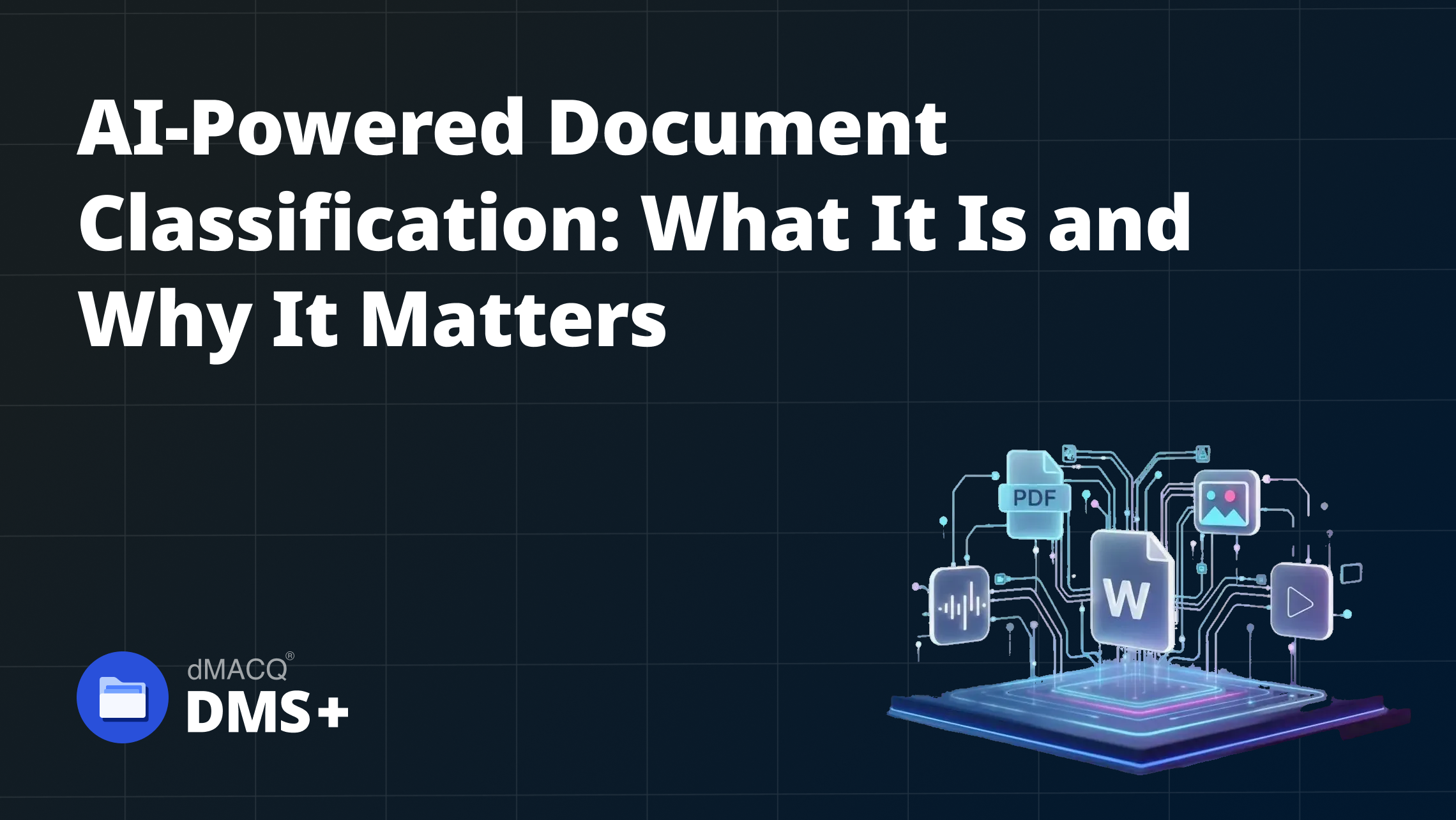
OCR converts scanned images, PDFs and photos into machine-readable text. Even handwritten notes, when properly preprocessed, can be read and classified.
Natural Language Processing (NLP)
NLP enables systems to understand meaning rather than just keywords. It helps differentiate between “contract renewal,” “non-disclosure agreement,” and “service level agreement,” even if they share similar words.
Machine Learning Models
Supervised learning models are trained with labeled examples so the system can recognize document types and context on its own, improving accuracy over time.
Contextual Metadata Analysis
AI uses not only text but also metadata — like author, date, project code and linked records — to make smarter classification decisions.
Why Traditional Classification Falls Short
Before AI, document classification was largely rule-based:
But these methods struggle when:
- Documents vary in format (PDF, DOCX, email)
- Content uses ambiguous language
- Organization structures evolve
- Metadata is missing or inconsistent
Rule-based systems can misclassify by up to 30–40% in complex environments leading to misinformation and inefficiency.
With AI, accuracy improves dramatically and classification errors become the exception, not the rule.
Why AI-Powered Classification Matters for Enterprise Record Management
Enterprises benefit from AI classification across multiple dimensions:
Instant Searchability
AI organizes content so employees can find what they need instantly regardless of format or repository.
Imagine searching for a contract based on clause content, not filename and getting accurate results immediately.
Better Compliance & Governance
Regulations like GDPR, SOX, HIPAA and industry-specific standards demand strict documentation controls.
AI classification helps enforce:
Documents aren’t just stored — they’re governed.
Elimination of Manual Errors
Manual tagging is inconsistent and slow. AI removes human bias and redundancy, ensuring that documents are consistently classified, even as records grow in volume and diversity.
Improved Operational Efficiency
Legal reviews, audits, compliance checks, vendor onboarding, HR file retrieval and customer service all become faster and more reliable when documents are correctly and automatically classified.
Scalability
AI scales effortlessly. As companies accumulate millions of documents, AI doesn’t slow down — it improves with more data.
How DMS+ Implements AI-Powered Classification
DMS+ goes beyond traditional document management by embedding AI classification capabilities into its core:
Smart Indexing
Documents scanned or uploaded are automatically indexed based on content, context and metadata — no manual tagging needed.
Content-Aware Search
Users can search by keywords, semantic meaning, clauses, phrases, or topic clusters — and get precise results from any repository.
Automatic Document Type Detection
Whether it’s a contract, invoice, employee record, or compliance certificate, DMS+ identifies and categorizes it without human intervention.
Continuous Learning
The classification model improves over time as more documents are processed — reducing errors and accelerating retrieval performance.
Auditable Classification Trails
DMS+ logs how and why a document was categorized — providing transparency and traceability for compliance and governance.
Real World Impact
Organizations that adopt AI-powered classification report measurable benefits:
- 80% faster document retrieval
- 60% reduction in manual processing costs
- Better compliance during audits
- Reduced legal and operational risk
- Improved cross-team collaboration
AI doesn’t just save time — it enables better decisions and stronger compliance across the business.
Use Cases for AI Classification Across Industries
The Future of Document Intelligence in 2026 and Beyond
By 2026, document systems will no longer be judged on storage capacity alone.
Success will be measured by:
- Automated retention and lifecycle management
AI-powered document classification turns static repositories into living knowledge systems — helping businesses detect patterns, enforce policies and maximize the value of their data.
Conclusion
AI-powered document classification is more than a feature — it’s a strategic necessity for modern enterprises.
It ensures that documents are:
With DMS+, companies can confidently manage growing information volumes and complex compliance landscapes without drowning in manual effort.