Introduction
Despite rapid digital transformation, many organizations still depend on paper records to run critical business processes.
Contracts are stored in filing cabinets. Customer records sit in archive rooms. Employee files are maintained in physical folders. Engineering drawings, compliance documents, invoices and legal records often exist only as paper documents spread across multiple locations.
While these records may appear organized, they introduce delays every time information needs to be found, shared, verified or processed.
Paper records don't just consume physical space—they slow business operations, reduce visibility, increase operational costs and make it harder for organizations to scale.
In this blog, we'll explore why paper-based record management creates operational challenges, the business impact of relying on physical documents and how DIGI+ helps organizations digitize records to improve accessibility, efficiency and business agility.
Why Paper Records Become an Operational Bottleneck
Paper records were designed for a different era of business.
Today's organizations operate across multiple offices, remote teams, digital workflows and integrated enterprise systems. Physical documents cannot move at the same speed as digital business processes.
Every time an employee needs a document, someone must locate it, retrieve it, verify the correct version and often scan or courier it before work can continue. The document becomes the bottleneck instead of enabling the process.
How Paper Records Slow Business Operations
1. Information takes longer to retrieve
Finding a paper document often involves searching through storage rooms, filing cabinets or archived boxes. Even when records are well organized, locating the correct document consumes valuable time. This affects processes such as:
Business decisions slow down simply because information is not immediately available.
2. Collaboration becomes difficult
Modern business relies on multiple departments working together. When documents exist only in physical form:
- teams cannot access them simultaneously
- records must be photocopied or scanned repeatedly
- documents move between offices
- employees wait for files to become available
Instead of enabling collaboration, paper records create dependency on physical movement.
3. Business processes become slower
Many operational workflows depend on supporting documents. If those documents exist only on paper, processes such as approvals, audits, onboarding, contract reviews or vendor verification cannot move efficiently.
Employees spend time locating documents instead of completing business tasks. As document volumes grow, these delays multiply across the organization.
4. Higher risk of document loss and damage
Paper records are vulnerable to:
Recovering lost documents is often expensive—and in some cases, impossible. For compliance-sensitive industries, missing records can also create legal and regulatory risks.
5. Compliance and audits become more time-consuming
Audits require organizations to produce accurate and complete documentation quickly. With paper-based records, audit preparation often involves manually collecting files from different departments or storage locations. This increases:
- risk of incomplete documentation
- compliance-related delays
Digitized records make audit readiness significantly easier.
The Hidden Business Costs of Paper Records
The cost of paper records extends beyond printing and storage. Organizations also spend time and money on:
- transportation of records
- delayed business processes
While each activity may seem minor, together they reduce overall operational efficiency. The larger the organization, the greater the impact.
Why Digitization Is More Than Scanning Documents
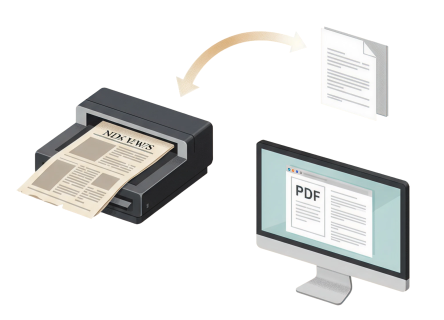
Many organizations believe digitization simply means converting paper into PDF files. In reality, effective document digitization involves much more. A successful digitization initiative should:
- convert physical records into searchable digital files
- classify documents logically
- capture metadata for easy retrieval
- index records for faster search
- preserve document quality
- maintain security throughout the process
- prepare records for integration with document management and business systems
Digitization transforms records into usable business information and not just digital images.
Benefits of Digitizing Paper Records
Digitized records help organizations improve efficiency across multiple business functions. Key benefits include:
- faster document retrieval
- improved collaboration across locations
- reduced dependency on physical storage
- easier compliance and audit preparation
- improved business continuity
- lower administrative effort
- stronger foundation for workflow automation and document management
Instead of slowing business processes, documents become instantly available whenever they are needed.
How DIGI+ Helps Organizations Modernize Physical Records
DIGI+ helps organizations convert paper archives into structured, searchable digital records that are ready for business use.
- Secure document digitization: Physical documents are digitized using structured processes that help preserve document quality and improve long-term accessibility.
- Intelligent indexing and metadata capture: Documents are indexed with relevant metadata, making them easier to search and retrieve without manually browsing through folders.
- Centralized digital archives: Instead of maintaining scattered physical files or ganizations can build centralized digital repositories that improve accessibility across departments and locations.
- Faster access to business-critical information: Digitized records allow employees to locate documents quickly, reducing delays in approvals, customer service, audits, compliance and operational processes.
- Foundation for digital transformation: Digitized records can integrate with document management systems, workflow automation platforms, ERP systems and other enterprise applications, enabling organizations to modernize business processes beyond simple document storage.
Real-World Impact
Consider an organization maintaining thousands of physical documents across multiple offices. Every day, employees spend time locating files, requesting records from archives, scanning documents, sending physical copies and waiting for information before work can continue.
Now imagine the same organization after digitizing its records. Documents become searchable within seconds. Teams across locations access the same records simultaneously. Compliance teams prepare audits faster. Customer requests are resolved more quickly. Operational delays caused by document retrieval are significantly reduced.
The business impact is substantial:
- faster access to information
- reduced administrative effort
- stronger compliance readiness
- lower document handling costs
- better operational efficiency
- improved business continuity
- greater scalability as document volumes grow
Instead of acting as barriers, business records become accessible assets that support faster decision-making and smoother operations.
Conclusion
Paper records may have supported businesses for decades, but they are no longer suited to the speed and complexity of modern enterprise operations.
As organizations grow, physical records create delays, increase operational costs, limit collaboration and make compliance more difficult. Every minute spent searching for, transporting or managing paper documents is time that could be spent delivering value to customers and growing the business.
Digitization changes that.
With DIGI+ or ganizations can transform physical records into structured digital assets that are easy to access, secure and ready to support document management, workflow automation, compliance and enterprise-wide digital transformation. Because in today's business environment, information creates value only when it is available exactly when and where it is needed.